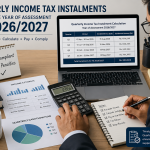












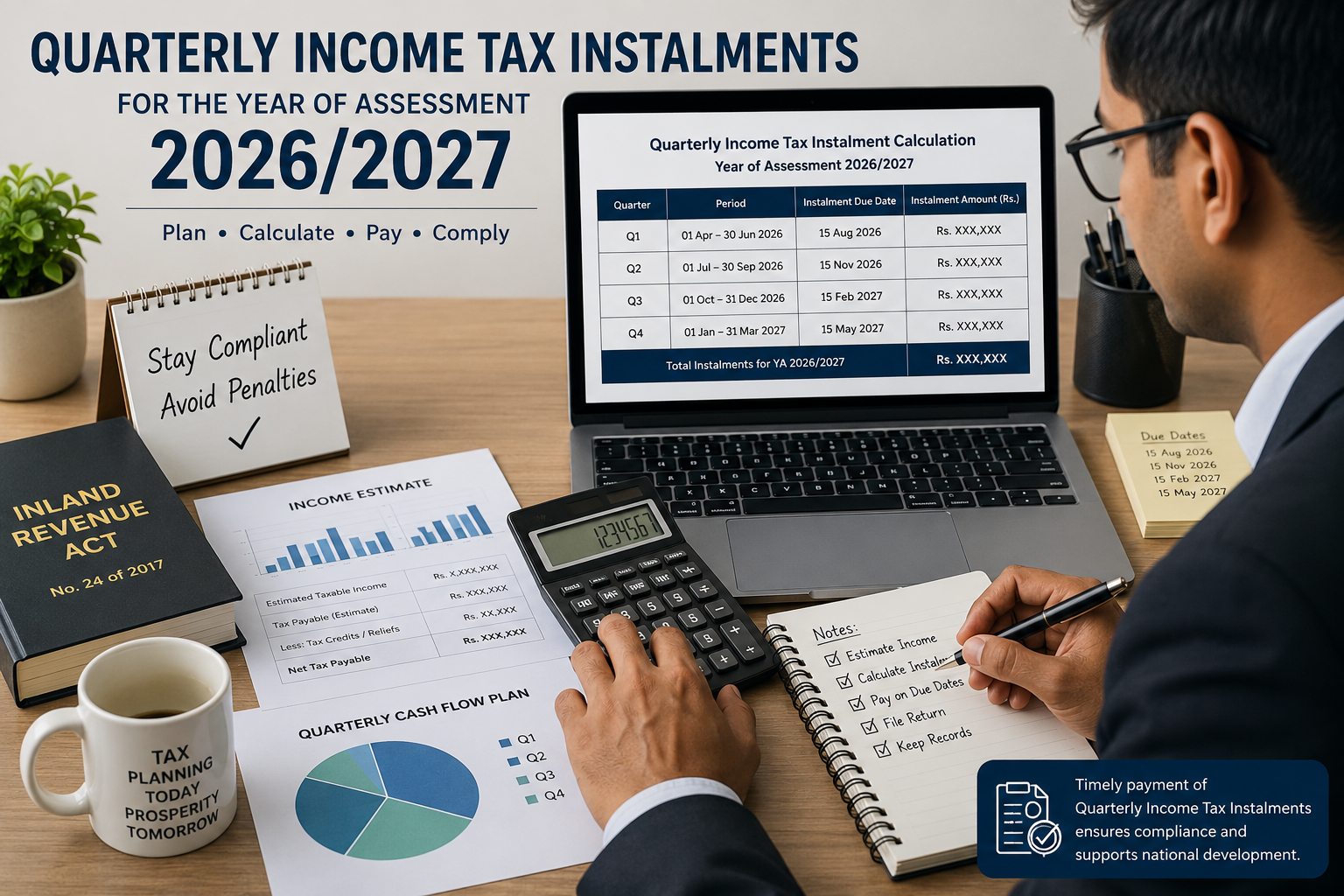
The Inland Revenue Department (IRD) has recently issued a revised circular, SEC/2026/E/06 (Revised), dated August 06, 2026. This document outlines the official methodology for computing quarterly income tax instalments, applicable for the Year of Assessment 2026/2027 and subsequent years.
For members of the Lanka Tax Club and taxpayers across the country, understanding these procedures is essential to ensure compliance and avoid penalties. Here is a breakdown of the key statutory requirements, calculation formulas, and administrative rules introduced in the circular.
Read LTC News Letter on Revised IRD Circular on Quarterly Income Tax Instalments
Statutory Due Dates
According to Section 90 of the Inland Revenue Act, No. 24 of 2017, taxpayers are required to pay their quarterly instalments on or before the following statutory deadlines:
- 1st Instalment: On or before August 15th of the Year of Assessment.
- 2nd Instalment: On or before November 15th of the Year of Assessment.
- 3rd Instalment: On or before February 15th of the Year of Assessment.
- 4th Instalment: On or before May 15th of the next succeeding Year of Assessment.
The Standard Calculation Formula
To calculate the income tax payable for each specific instalment, the IRD utilizes the following formula:
( A – C ) / B
Here is how the variables are defined:
| Variable | Definition |
| A | The amount of tax payable by the person on the taxable income for the immediately preceding year of assessment. This is the gross tax payable before deducting any tax credits. |
| B | The number of instalments remaining for the Year of Assessment, including the current instalment. (e.g., $B=4$ for the 1st Instalment, $B=1$ for the 4th Instalment). |
| C | The total tax paid during the year of assessment prior to the instalment’s due date. This includes previous instalment payments and Withholding Tax (WHT) / Advance Income Tax (AIT) credits. |
Methods for Determining Component “A”
The circular specifies three distinct methods for calculating component “A”, depending on the taxpayer’s circumstances.
Method 1: Standard Basis
This is the default method for taxpayers who had taxable income in the preceding year. “A” simply equals the gross income tax liability of the immediately preceding year of assessment.
- Compliance Note: No additional documentation needs to be filed with the Commissioner-General when using this standard basis.
- Important: If you are eligible to use this standard method, you cannot use the alternative methods outlined below.
Method 2: Alternative Bases
Alternative methods are strictly reserved for taxpayers who either had no prior tax liability in the preceding year or who reasonably expect their current year’s taxable income to be lower.
- No Preceding Taxable Income & No Current Assessable Income Expected: “A” is considered zero. While no payment is due, the taxpayer must submit the specified “Attachment 1” statement.
- No Preceding Taxable Income, but Current Assessable Income is Expected: This applies if losses are expiring or tax exemptions are ending. Taxpayers must estimate “A” based on the preceding year’s figures while disregarding those expiring losses or exemptions. Submission of “Attachment 1” is required.
- Previous Income Existed, but Significant Reduction Expected: If a taxpayer anticipates lower income due to a significant decline in business or lost investments, they can recalculate the previous year’s tax by excluding the discontinued gains or profits. This requires submitting “Attachment 1” along with supporting calculation details.
- Newly Registered Taxpayers: New taxpayers must estimate their taxable income for the current year to calculate “A”. They are required to submit “Attachment 2”.
Method 3: Taxpayers Unable to Estimate
If unusual circumstances make it practically impossible to calculate “A” using the alternative bases, the taxpayer must submit a written request to the Commissioner Tax Policy and Legislation Unit to seek a reasonable alternative method.
General Administrative Rules & Exemptions
The circular also outlines several vital administrative clarifications:
- Submission Deadlines: Required attachments (like Attachment 1 or 2) must be submitted to the Central Document Management Unit (CDMU), Metro, or the relevant Regional Office by August 15th of the year the first instalment is due.
- Credit Schedules: To account for component “C” (tax credits), taxpayers must submit a credit schedule to the CDMU or relevant office by the last day of the month in which the quarterly instalment is due (e.g., August 31 for the first instalment).
- Employment Income Exemptions: If an individual’s income is derived solely from employment and is fully subject to Advance Personal Income Tax (APIT), they do not need to pay quarterly instalments or submit credit schedules. This exemption also applies if the taxpayer has rent or interest income, provided the Advance Income Tax (AIT) deducted covers the remaining tax liability.
- Mid-Year Revisions: Taxpayers using the Standard Basis (Method 1) can request a mid-year revision if their projected taxable income drops below the preceding year’s figures. This request must be submitted with supporting information to the CDMU by the last day of the month preceding the next instalment due date (e.g., October 31, January 31, or April 30).