

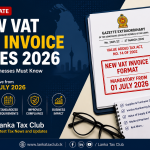






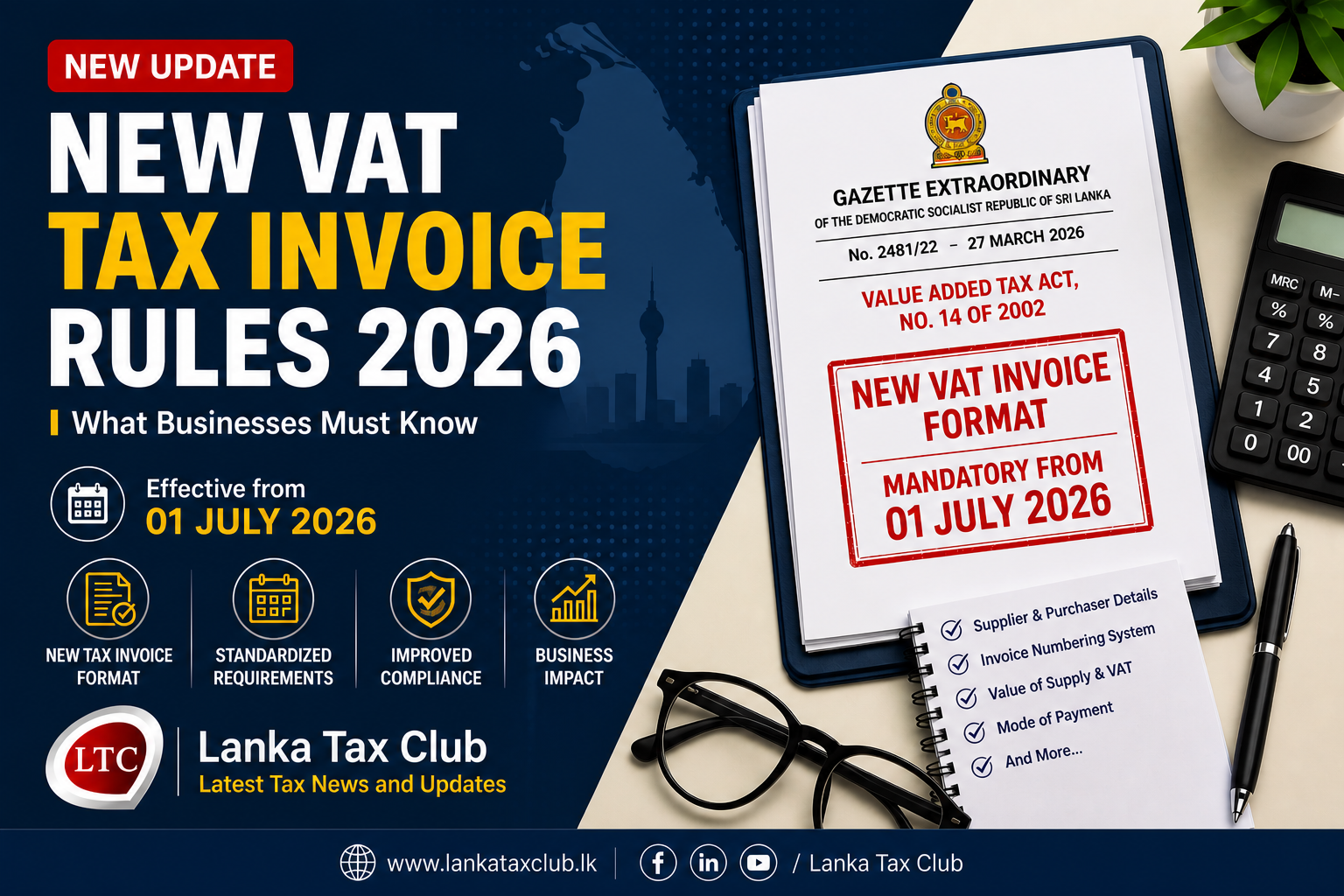
The Commissioner General of Inland Revenue has issued a new directive outlining updated formatting and specifications for Value Added Tax (VAT) invoices. Published in the Gazette Extraordinary No. 2481/22 on March 27, 2026, these new rules aim to standardize tax documentation across Sri Lanka.
Here is a comprehensive breakdown of the new requirements and how they will impact registered persons.
Watch Video
Effective Date and Transition
- The new tax invoice specifications will become strictly effective from July 01, 2026.
- The previous format and specifications, issued under Gazette Notification No. 2463/05 on November 17, 2025, will remain optional until the transition date.
- With effect from July 01, 2026, the older November 2025 guidelines are officially rescinded.
Core Structural Requirements
To comply with the new mandate, every tax invoice must adhere to specific structural guidelines:
1. Title and Identification
- The document must be prominently titled “TAX INVOICE“.
- This title must appear in a conspicuous place on the face of the invoice.
- The title must use bold or highlighted text to guarantee clear identification.
2. Supplier and Purchaser Details
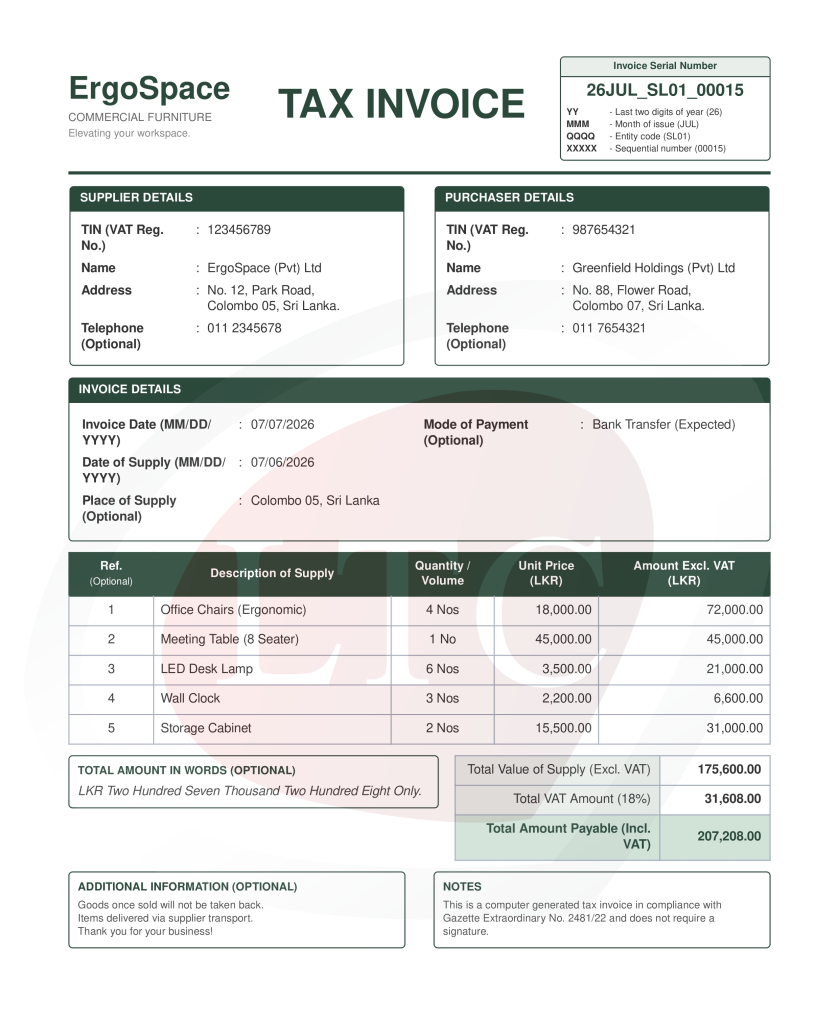
- Supplier Information: The top left-hand corner must display the supplier’s 9-digit Taxpayer Identification Number (TIN) issued by the Commissioner General of Inland Revenue, along with the supplier’s name and address. Including a telephone number is optional.
- Purchaser Information: Located in the top right-hand corner or directly below the supplier’s particulars, the invoice must list the purchaser’s 9-digit TIN, name, and address. The purchaser’s telephone number is also optional.
The New Standardized Serial Number Format
One of the most significant updates is the strict standardization of the Invoice Serial Number. All registered persons must format their invoice numbers without spaces, limited to a maximum of 40 characters, using the exact structure YYMMM_QQQQ_XXXXX:
- YY: Represents the last two digits of the calendar year.
- MMM: Represents the first three characters of the issue month in uppercase letters.
- QQQQ: An alphanumeric code (between 1 and 15 digits) used to identify organizational entities like branches, sections, or projects.
- XXXXX: The numeric serial number of the invoice, containing strictly numerical characters with no alphabet letters or symbols. This numbering must continue from the previous month, though businesses may restart the sequence at the beginning of each month or year if necessary.
- Example: The first tax invoice issued in July 2026 by Branch 03 (BR03) could be formatted as
26JUL_BR03_1.
Essential Invoice Data
In addition to the parties’ details and the serial number, the invoice must clearly state:
- Dates: Both the Date of Invoice and the Date of Supply must be formatted as MM/DD/YYYY.
- Item Breakdown: A clear description of the goods or services supplied, along with the measurable quantity or volume.
- Financial Values: All values must be stated in Sri Lankan Rupees (LKR), inclusive of cents, and expressed to two decimal places. The invoice must separately show the net value of the supply (exclusive of VAT), the VAT amount charged, and the total consideration inclusive of VAT.
- Exclusive VAT Content: Importantly, the tax invoice must exclusively include only those goods or services that are subject to VAT.
Flexibility and Optional Elements
While the gazette enforces strict core rules, it does provide businesses with operational flexibility:
- Suppliers are permitted to modify the specimen format provided in the gazette, as long as it conforms to the mandated specifications.
- Additional rows or columns can be added to capture further information related to the supply.
- Businesses may display their logos, trademarks, or other relevant headers/footers.
- Optional fields include the Place of Supply, the total consideration written in words, specific additional supply information, and the Mode of Payment (e.g., Cash, Bank Transfer, Cheque, Online Payment).
Download Gazette No. 2481/22 | English | Sinhala
Sample TAX INVOICE Format