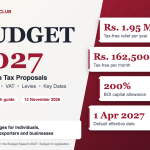









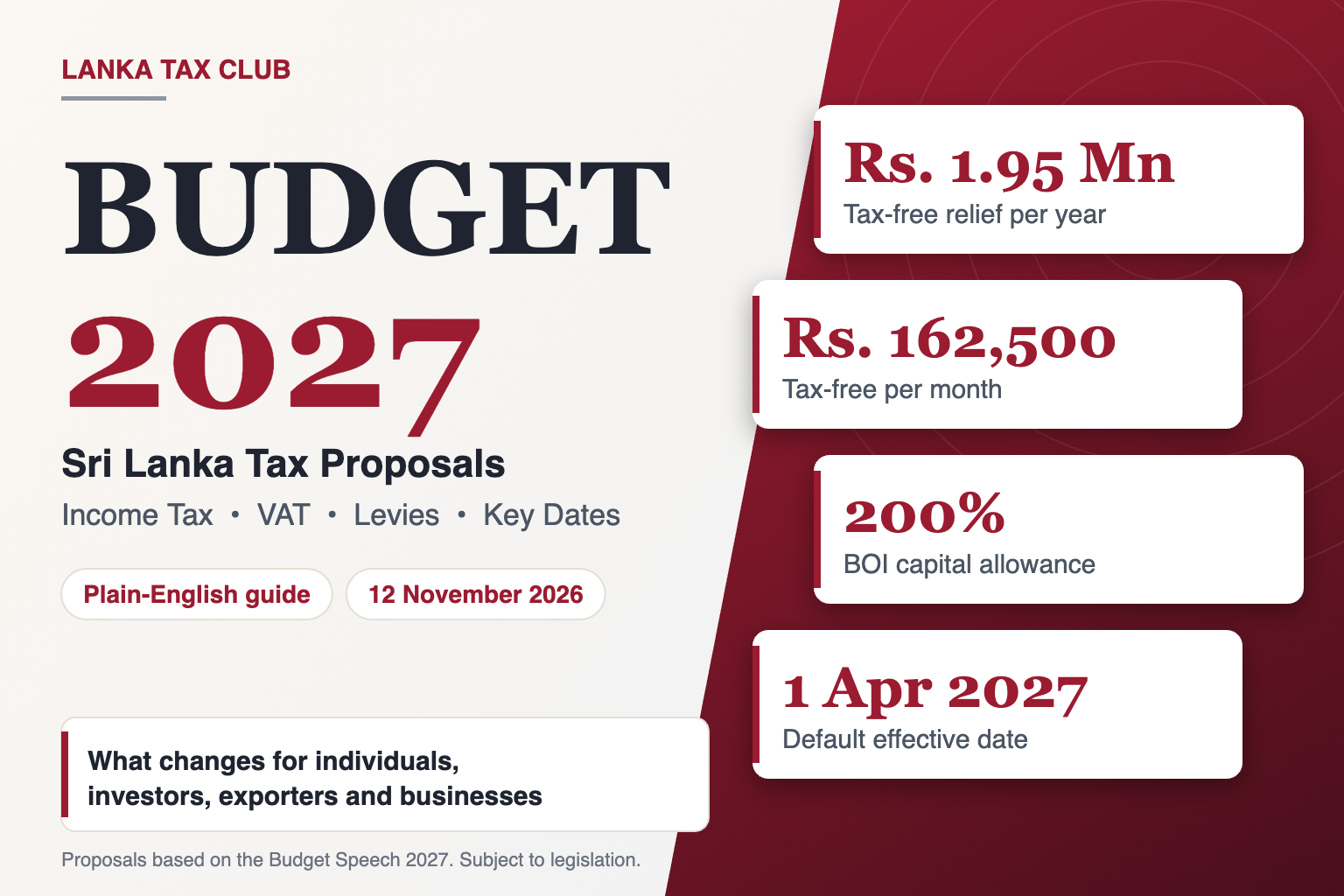
On 12 November 2026, the Minister of Finance, Planning and Economic Development presented the 2027 Budget to Parliament. The tax measures are modest in number but touch most taxpayers: a higher tax-free threshold, a new capital allowance for BOI investors, a wider Capital Gains Tax base, and a long list of VAT and levy changes.
In short
- The annual personal income tax relief rises from Rs. 1.80 million to Rs. 1.95 million, and the slabs are widened (a 12% rate is added).
- BOI enterprises in export manufacturing or tourism that invest at least USD 3 million can opt for a 200% capital allowance.
- Capital Gains Tax will cover digital and virtual assets, certain licences, and high-value movable assets.
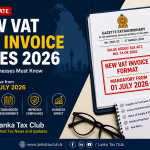
- Books and printed material become exempt from VAT; electronic tax invoices become legally valid.
- The Tourism Development Levy is abolished, CESS falls by 25% on 800 lines, and SCL changes apply from 13 November 2026.
•The fiscal backdrop
The Budget is the Government’s third. It sets a medium-term aim of keeping government revenue at no less than 16% of GDP, rising to about 20% in the long term. The speech says revenue reached 16.6% of GDP in 2025. To get there, it points to reforms that broaden the tax base, rationalise exemptions and incentives, digitalise tax administration and strengthen compliance. It also targets a primary surplus of 2.3% of GDP and a budget deficit below 5%.
That context matters for reading the tax measures. The relief for individuals and some sectors is real, but the direction of travel is a wider base and fewer exemptions, not lower revenue.
The relief is real, but the direction of travel is a wider base and fewer exemptions.
1Personal income tax: higher relief and wider slabs
In 2025, the annual tax-free relief rose from Rs. 1.2 million to Rs. 1.8 million. The 2027 Budget raises it again to Rs. 1.95 million. A person who earns up to Rs. 162,500 a month in salary and allowances will pay no tax on it.
The rate structure changes as well. The first 6% band becomes narrower (Rs. 850,000 instead of Rs. 1,000,000), and every later band widens to Rs. 600,000. A 12% rate now sits between 6% and 18%.
| Present taxable income | Rate | Proposed taxable income | Rate |
|---|---|---|---|
| First Rs. 1,000,000 | 6% | First Rs. 850,000 | 6% |
| Next Rs. 500,000 | 18% | Next Rs. 600,000 | 12% |
| Next Rs. 500,000 | 24% | Next Rs. 600,000 | 18% |
| Next Rs. 500,000 | 30% | Next Rs. 600,000 | 24% |
| Balance | 36% | Next Rs. 600,000 | 30% |
| Balance | 36% |
The bands apply to income above the annual relief. The point at which the top rate of 36% starts moves from Rs. 358,000 a month to Rs. 433,000 a month.
What it could mean each month
The Budget Speech says each individual taxpayer gains between Rs. 750 and Rs. 15,750 a month from the 2027 changes. Combined with the 2025 reforms, total monthly relief ranges from Rs. 4,250 to Rs. 36,250. We applied the proposed bands to a few salary levels to show how the saving builds up.
| Monthly income (Rs.) | Tax now (Rs.) | Proposed tax (Rs.) | Monthly saving (Rs.) |
|---|---|---|---|
| 200,000 | 3,000 | 2,250 | 750 |
| 250,000 | 8,000 | 6,250 | 1,750 |
| 300,000 | 18,500 | 13,250 | 5,250 |
| 400,000 | 50,000 | 36,250 | 13,750 |
| 500,000 and above | Varies | Varies | 15,750 |
2A 200% capital allowance for BOI investors
BOI-approved enterprises in export-oriented manufacturing or tourism development can opt for a capital allowance of 200% of qualifying capital expenditure, in place of the existing regime. The qualifying investment must be at least USD 3 million.
| Condition | Requirement |
|---|---|
| Minimum investment | USD 3 million |
| Sectors | Export-oriented manufacturing; tourism development |
| Investment period | Within 3 years for manufacturing and tourism other than hotels; within 5 years for hotels |
| Other allowances | The Fourth Schedule allowance and the enhanced allowance under the Second Schedule are not allowed alongside this option |
Because it is an election, investors will need to compare the 200% route against what they would otherwise claim. The investment windows are also fixed, so project timing will matter.
3Capital Gains Tax: a wider definition of “capital asset”
Section 195 of the Inland Revenue Act, No. 24 of 2017 will be amended so that three more groups of assets fall within Capital Gains Tax:
- Digital and virtual assets, including cryptocurrencies.
- Telecommunications, broadcasting and similar licences and rights that have commercial value.
- Gems, jewellery, precious metals and other valuable movable assets above a prescribed monetary threshold.
The Budget does not state the threshold or the start date. Until those are published, holders of these assets should keep records of acquisition cost and date.
4Value Added Tax (VAT)
VAT has the longest list of changes. Most of them clarify existing rules or help specific sectors.
| Measure | Proposal |
|---|---|
| Books and printed material | Import and supply exempt: exercise books (4820.20), printed books (4901.99.10), dictionaries and encyclopaedias (4901.91), children’s picture, drawing and colouring books (4903.00), printed matter in single sheets (4901.10), and music books and printed music (4904.00.10, 4904.00.90). Printed books were taxed from January 2024; exercise books were taxed earlier. |
| Exemptions removed | VAT exemption removed on Artemia eggs (0511.91.20) and coconut coir pith (1404.90.93). |
| Cinema tickets | Producers, distributors, the National Film Corporation and cinema hall operators each account for VAT on their own share of ticket revenue. The base is the ticket value after Entertainment Tax and before VAT. |
| Eligible Exporter | A newly VAT-registered person qualifies if more than 80% of turnover in the preceding six months came from exports. The preceding calendar year test does not apply to them. |
| Foreign currency supplies | The Central Bank indicative exchange rate will be used for VAT. The Commissioner General of Inland Revenue will set the method by circular. |
| Electronic tax invoices | Legally valid like paper invoices. The Commissioner General will set the format and technical rules by Gazette order. |
| Input tax claims | Uniform claim periods of 12 months for local purchases and 24 months for imports, regardless of when the return is filed. Credit and debit notes will be aligned with the time of the claim. NFE-basis transactions, non-tax invoices and the effect of exemptions will be clarified, and differences between the Sinhala and English texts corrected. |
| COVID-period returns | Input tax previously disallowed for late returns during the pandemic can be claimed, where the outstanding returns for that period were filed on or before 31 July 2026. The effective date and final conditions are yet to be announced. |
The input tax change is the one we expect many VAT-registered businesses to notice. A fixed claim window that does not depend on the return filing date removes a common source of disputes.
5SSCL, customs levies and other levies
Social Security Contribution Levy
The supply of bunker fuel to ships engaged in international transport will be expressly exempt from SSCL. The Budget links this to Sri Lanka’s aim of being a regional maritime hub.
Special Commodity Levy, from 13 November 2026
| Item | Change per kilogram |
|---|---|
| Imported sprats | Reduced from Rs. 100 to Rs. 10 |
| Maldive fish | Reduced from Rs. 302 to Rs. 10 |
| Dried chillies (powdered and unpowdered) | Reduced by Rs. 50 |
| Imported sugar | Increased by Rs. 10 |
CESS, PAL and the Tourism Development Levy
CESS rates fall by 25% across 800 HS code lines. The Budget does not give a date for this change. From 1 January 2027, the 10% Ports and Airports Development Levy is removed on newsprint and on batteries used for solar energy storage. The Tourism Development Levy, charged on the turnover of tourism establishments under the Finance Act, No. 25 of 2003, is abolished from 1 April 2027. Until a new financing mechanism is set, the Treasury will fund tourism promotion on request.
Betting and gaming, and the Excise Ordinance
The Gambling Regulatory Authority is now in place, so the Government will review taxes, fees and charges on betting and gaming. The aim is a simple, integrated structure without double taxation, and the Betting and Gaming Levy Act, No. 40 of 1988 is expected to be amended. The planned new Excise Act is still pending, so the existing Excise Ordinance will be amended in the meantime.
6Tax administration and compliance
The technical notes also list changes to the Inland Revenue Act and the VAT Act. Several of them will interest advisers.
| Area | Proposal |
|---|---|
| Cash transaction restriction | The Commissioner General will accept a certificate from an approved accountant or an authorised person to verify compliance with the statutory limit on cash transactions. |
| Company amalgamations | New anti-avoidance rules for mergers and amalgamations, without unduly affecting genuine ones. |
| NGO donations | Double taxation of donations between NGOs will be prevented, with proof that the original recipient NGO paid the tax. |
| Digital services (section 73) | The source of income from remote and digital services, including online advertising and cloud services, will be set by the place of payment. |
| Treaty wording (section 75(5)) | “Prevention of fiscal evasion” becomes “prevention of tax evasion and avoidance”, in line with the OECD and UN Model Conventions. |
| 14% withholding tax (section 85(1B)) | Clarified that the 14% WHT on service fees and insurance premiums applies only to payments to non-residents without a permanent establishment in Sri Lanka. |
| Information from foreign authorities | Disclosed only to persons authorised under the Act, and with the prior consent of the foreign tax authority. |
7Key dates
8What the Budget does not say yet
- The start date for the new personal income tax bands (we assume 1 April 2027).
- The start date for the 25% CESS reduction.
- The monetary threshold for gems, jewellery and other movable assets under Capital Gains Tax.
- The effective date and final conditions for the COVID-period VAT input tax relief.
- The detail of the new betting and gaming tax structure and the Excise Ordinance changes.
Our practical points
- Employers: expect revised APIT tables and plan payroll updates before 1 April 2027.
- BOI investors: model the 200% allowance against your current allowances before you elect, and check the 3-year and 5-year windows.
- Cross-border payments: the place-of-payment rule for digital services and the clarified 14% WHT scope may change how payments to non-residents are taxed. Review contracts with overseas service providers.
- Digital assets and valuables: keep acquisition cost and date records now, as the threshold and start date are still to come.
- Importers: check costing for sprats, Maldive fish, dried chillies and sugar from 13 November 2026.
This box is our own commentary and is not part of the Budget.
Conclusion
The 2027 tax measures give relief to individual taxpayers, investors, exporters, publishers and tourism businesses, while widening the Capital Gains Tax base and tightening anti-avoidance rules. The detail will sit in the amending Bills and IRD circulars, so the gaps listed above are the points to watch. We will update this article as the legislation is published.
Sources
- Budget Speech 2027 (81st Budget Speech), Minister of Finance, Planning and Economic Development, Parliament of Sri Lanka, 12 November 2026: Section 3 and Section 36.
- Budget Speech 2027, Annexure V, Technical Notes, Part I: Taxation.
- Inland Revenue Act, No. 24 of 2017; Value Added Tax Act, No. 14 of 2002; Social Security Contribution Levy Act, No. 25 of 2022.
This article is general information based on the Budget Speech 2027 and its technical notes. It is not tax or legal advice. The measures are proposals and may change when legislation is enacted. Please confirm the position with the Inland Revenue Department or a qualified tax adviser before acting.