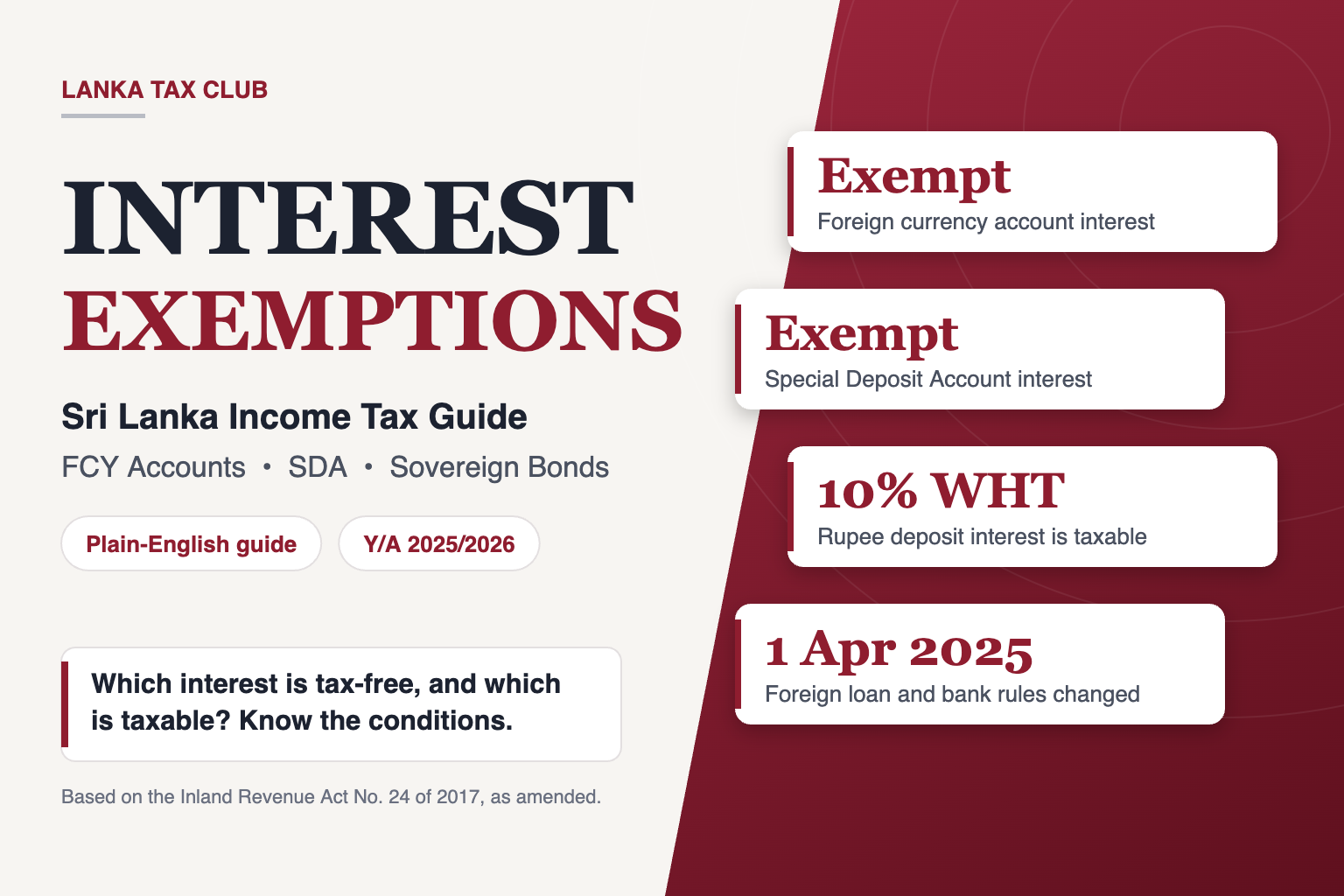







Many retired public officers ask the same question: is my Government pension subject to income tax? The answer for Y/A 2025/2026 (1 April 2025 to 31 March 2026) is mostly good news, but it has limits. This article explains what the Inland Revenue Act No. 24 of 2017 says, what is not covered, and how a pensioner with other income is taxed.
In short
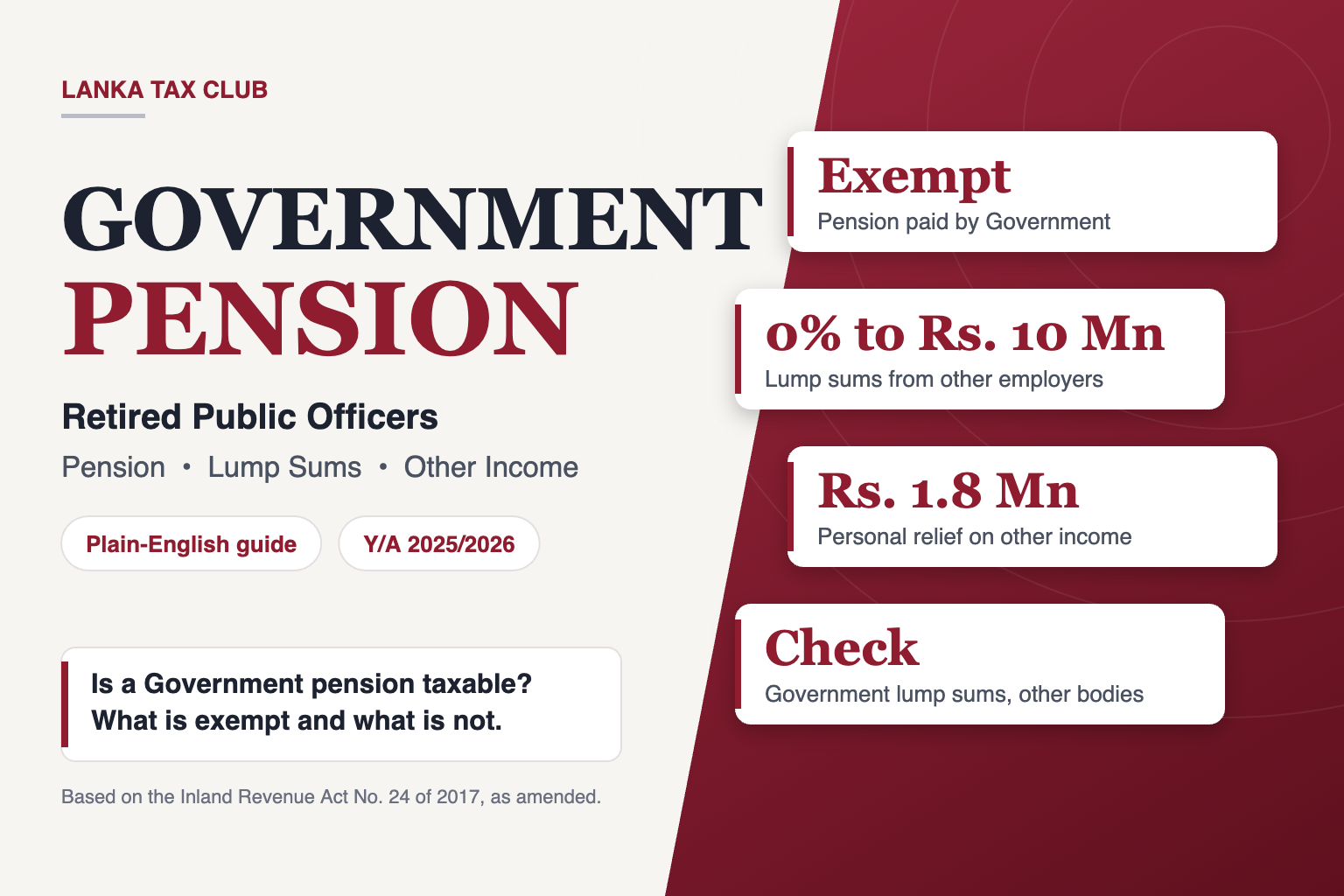
A pension paid by the Government of Sri Lanka, or by a Government department, is an exempt amount. It is not taxed. The IRD’s APIT circular SEC/2025/E/01 lists the same exemption. The wording of APIT Table 03 is wider and also covers retiring benefits paid by the Government, so confirm the position on Government lump sums. Lump sums from other employers, such as a commuted pension or retiring gratuity, are taxed under a separate scale, with the first Rs. 10,000,000 at 0% under the Act. Any other income the pensioner earns, such as rent, interest or business income, is taxed in the normal way.
The legal basis
Section 9 of the Inland Revenue Act lists “exempt amounts” and sets them out in the Third Schedule. Paragraph (c) of the Third Schedule exempts “the pension of a person where the pension income is paid by the Government of Sri Lanka or a department of the Government of Sri Lanka”.
An exempt amount is not part of taxable income. It does not use up the personal relief or any tax band, and no Advance Personal Income Tax (APIT) is deducted on it.
What the exemption covers
- The monthly pension. A pension paid by the Government of Sri Lanka or a Government department is fully exempt, whatever the amount.
- No residence test. The paragraph refers to the pension “of a person”. It is not limited to residents.
- Retiring benefits: confirm the position. The Act and the IRD’s APIT circular SEC/2025/E/01 (25 March 2025) list only the pension as exempt. APIT Table 03 is wider and lists any pension or retiring benefit paid by the Government or a Government department as exempt. A Government gratuity or commuted pension is therefore treated as exempt from APIT in that table, but check before relying on it in the final return.
- Employment income rules. Pensions are normally employment income under section 5(2)(a). The Third Schedule exemption takes a Government pension out of that income.
What the exemption does not cover
1. Lump sums from other employers. Paragraph (c) of the Act refers only to “the pension”. APIT Table 03 goes further and treats retiring benefits paid by the Government as exempt, but the Act and the circular do not repeat this. For lump sums paid by any other employer, the Act treats these as separate types of employment income (First Schedule, paragraph 1(3)):
- an amount received in commutation of a pension;
- a retiring gratuity;
- compensation for loss of office under a scheme that applies uniformly to all employees; and
- an amount paid at or after retirement from the Employees’ Trust Fund.
From 1 January 2020 these are taxed on a separate scale (First Schedule, paragraph 1(2)(b)(iii)):
| Total of these lump sums for the year | Tax payable |
|---|---|
| Up to Rs. 10,000,000 | 0% |
| Over Rs. 10,000,000 up to Rs. 20,000,000 | 6% of the amount over Rs. 10,000,000 |
| Over Rs. 20,000,000 | Rs. 600,000 plus 12% of the amount over Rs. 20,000,000 |
Most retirees therefore pay no tax on these lump sums under the Act. APIT Table 03 separately tells employers and the ETF to retain 12% of the excess over Rs. 5,000,000 from commuted pension, retiring gratuity and ETF payments. Nothing is withheld if total remuneration plus these payments does not exceed Rs. 1,800,000. This is an advance deduction, and the retiring employee can apply to the IRD for a direction within 90 days. The table does not state a year and its Rs. 5,000,000 figure differs from the Rs. 10,000,000 band in the Act, so confirm the current deduction with the IRD. Section 5(3)(g) also excludes retirement payments from employment income where the retirement contributions were already taxed in an earlier year. Whether a particular lump sum qualifies depends on how it was paid, so keep the payment advice.
2. Pensions from other bodies. The paragraph names the Government of Sri Lanka and its departments. Read literally, it does not name public corporations, statutory boards, provincial councils or local authorities. If a pension is paid by one of these, check the position before treating it as exempt.
3. Other income. The exemption applies only to the pension. Rent, interest, business profits, investment gains and any post-retirement employment income remain taxable.
A pensioner with other income
Because the Government pension is exempt, it is left out of the calculation. The resident individual’s personal relief of Rs. 1,800,000 for each year of assessment from 1 April 2025 (Fifth Schedule) is then set against the other income. The tax rates for Y/A 2025/2026 are below. They match the bands in the IRD’s APIT Table 02 (nil up to Rs. 1,800,000, then 6%, 18%, 24%, 30% and 36%).
| Taxable income | Tax payable |
|---|---|
| Up to Rs. 1,000,000 | 6% |
| Rs. 1,000,000 to Rs. 1,500,000 | Rs. 60,000 plus 18% of the excess over Rs. 1,000,000 |
| Rs. 1,500,000 to Rs. 2,000,000 | Rs. 150,000 plus 24% of the excess over Rs. 1,500,000 |
| Rs. 2,000,000 to Rs. 2,500,000 | Rs. 270,000 plus 30% of the excess over Rs. 2,000,000 |
| Over Rs. 2,500,000 | Rs. 420,000 plus 36% of the excess over Rs. 2,500,000 |
Example
A retired Government officer receives a pension of Rs. 3,000,000 a year. Her other taxable income, after allowable deductions, is Rs. 2,500,000 from rent.
- The pension of Rs. 3,000,000 is exempt and left out.
- Taxable income: Rs. 2,500,000 less personal relief of Rs. 1,800,000 = Rs. 700,000.
- Tax: 6% of Rs. 700,000 = Rs. 42,000.
- Any tax withheld on the rent or interest is credited against this amount.
Practical points
- No APIT on the pension. The Department paying a Government pension should not deduct APIT on it.
- Check the payer. Confirm whether your pension is paid by the Government or a Government department, or by another body.
- Keep records. Keep the pension payment advice and the retirement lump sum statements in case the IRD asks.
- Declare other income. Where a return is required, show the pension as exempt income and include all other income.
Conclusion
A Government pension is exempt from income tax under paragraph (c) of the Third Schedule, so a retired officer living on the pension alone pays no income tax on it. APIT Table 03 also treats retiring benefits paid by the Government as exempt, but the Act and the APIT circular mention only the pension, so confirm Government lump sums with the IRD. Lump sums from other employers are taxed on a separate scale, and most fall within the 0% band. Other income is taxed in the normal way after the Rs. 1,800,000 personal relief. Pensions paid by bodies other than the Government and its departments need a separate check.
Sources
- Inland Revenue Act No. 24 of 2017 (consolidated up to 2025), sections 5 and 9, Third Schedule paragraph (c), First Schedule paragraph 1
- Inland Revenue (Amendment) Act No. 10 of 2021
- Inland Revenue (Amendment) Act No. 45 of 2022
- Inland Revenue (Amendment) Act No. 2 of 2025
- IRD Circular SEC/2025/E/01 (25 March 2025): Guideline for Employers on Deducting APIT from Employment Income
- IRD APIT Tax Tables 2025/2026, Tables 02 and 03 (www.ird.gov.lk)
Attachment: IRD APIT Circular
Guideline for Employers on Deducting Advance Personal Income Tax (APIT) from Employment Income, Circular No. SEC/2025/E/01 dated 25.03.2025 (effective for Y/A 2025/2026 onwards), issued by the Inland Revenue Department.
Download the Circular (PDF)