













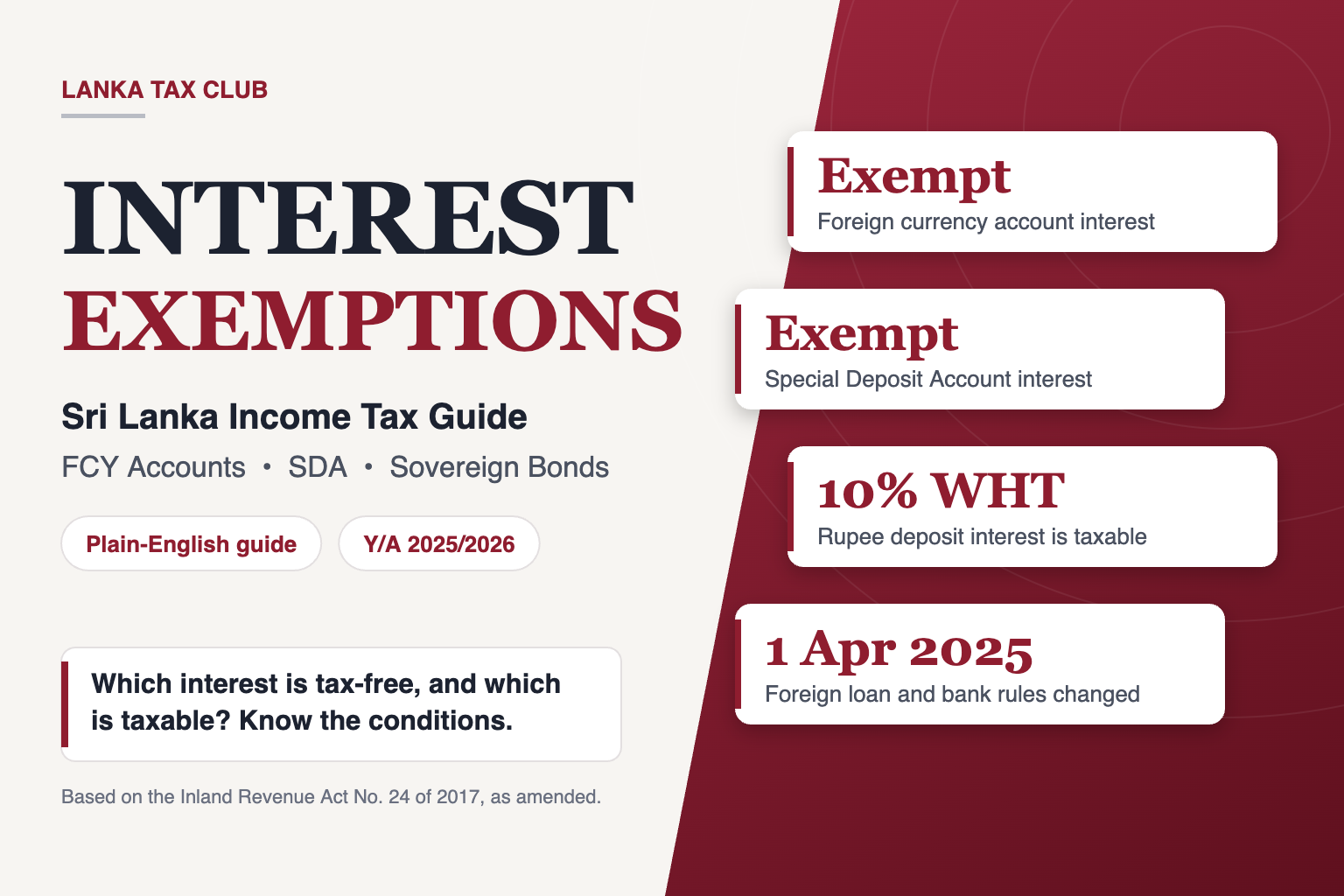
Interest is taxable in Sri Lanka unless a specific exemption applies. Banks deduct 10% withholding tax on most interest they pay, so many taxpayers assume all interest is taxed. That is not the case. The Inland Revenue Act No. 24 of 2017 exempts several types of interest,. This article explains each exemption for Y/A 2025/2026 (1 April 2025 to 31 March 2026).
In short
Interest on a foreign currency account with a Sri Lankan bank is exempt. So is interest on a Special Deposit Account, on foreign currency sovereign bonds, and on certain loans from outside Sri Lanka. Ordinary rupee deposit interest is taxable. This article goes through each exemption, with section references and practical points.
Where the exemptions come from
Section 9 of the Inland Revenue Act lists amounts that are “exempt amounts” and sets them out in the Third Schedule. The interest exemptions sit in paragraphs (i) and (l) of that Schedule. Paragraph (i) was replaced by the Inland Revenue (Amendment) Act No. 10 of 2021.
An exempt amount is not part of taxable income. It does not use up the personal relief or any tax band.
1. Interest on a foreign currency account
Paragraph (i)(iii) of the Third Schedule exempts interest earned by any person on money held in foreign currency in a foreign currency account. Three conditions apply:
- The account must be in foreign currency. Interest on rupee balances does not qualify.
- The bank must be a commercial bank or a specialised bank.
- The account must be opened with the approval of the Central Bank of Sri Lanka, on or after 1 January 2020. The Act does not say that the account holder must apply to the Central Bank personally. Accounts opened under the Central Bank’s general rules for foreign currency accounts are normally treated as approved. Keep the bank’s confirmation of the account type.
The exemption applies to “any person”. It is not limited to individuals, so companies can also use it.
2. Interest on a Special Deposit Account
Paragraph (i)(iv) exempts interest from a term deposit titled “Special Deposit Account”. The account must be opened and kept with an authorised dealer in Sri Lanka, as prescribed by regulations under section 29 read with section 7 of the Foreign Exchange Act No. 12 of 2017.
- It can be held in a designated foreign currency or in rupees.
- It applies to deposits opened on or after 8 April 2020.
- Renewals are excluded. Interest on a renewed deposit does not qualify.
3. Interest on sovereign bonds
Two exemptions apply to government bonds.
- Foreign currency sovereign bonds. Interest or discount on sovereign bonds denominated in foreign currency, including Sri Lanka Development Bonds, issued by or on behalf of the Government, is exempt for any person.
- Non-residents. A non-resident person (other than a Sri Lankan permanent establishment) is exempt on interest, discount or gains on sovereign bonds denominated in local or foreign currency.
4. Interest on loans from outside Sri Lanka
Paragraph (i)(ii) exempts interest paid to a person outside Sri Lanka on a loan given to a person in Sri Lanka or to the Government. The Inland Revenue (Amendment) Act No. 11 of 2026 adds two conditions with effect from 1 April 2025:
- The loan amount must be remitted to Sri Lanka in foreign currency through a bank.
- The loan proceeds must be used within Sri Lanka.
Borrowers should check that both conditions are met before treating the interest as exempt. If the loan does not meet them, withholding tax on the interest may apply.
Summary of exempt interest
| Type of interest | Reference | Key conditions |
|---|---|---|
| Foreign currency account | Third Schedule para (i)(iii) | Commercial or specialised bank; Central Bank approval; opened on or after 1 January 2020 |
| Special Deposit Account | Third Schedule para (i)(iv) | Authorised dealer; opened on or after 8 April 2020; renewals excluded |
| Foreign currency sovereign bonds | Third Schedule para (l) | Includes Sri Lanka Development Bonds |
| Sovereign bonds held by non-residents | Third Schedule para (l)(i) | Not a Sri Lankan permanent establishment |
| Loans from outside Sri Lanka | Third Schedule para (i)(ii) | From 1 April 2025: remitted in foreign currency through a bank and used in Sri Lanka |
What is not exempt
Taxable interest
- Rupee deposits and savings. Interest on ordinary rupee accounts and fixed deposits is taxable. Banks withhold 10% from 1 April 2025 (First Schedule, paragraph 10). For a resident individual this is not a final tax, so it is credited against the tax liability on the return.
- Interest paid to non-residents (other than the exempt categories above) is subject to 10% final withholding tax.
- Interest from overseas bank accounts. From 1 April 2025, the exemption for foreign-source income remitted through a bank has ended (Inland Revenue (Amendment) Act No. 2 of 2025). Such income, if earned in foreign currency and remitted through a bank, is taxed at a concessionary rate of up to 15%.
What changed for Y/A 2025/2026
- 10% WHT on interest applies from 1 April 2025 (increased from 5%).
- Foreign-source income exemption ended on 1 April 2025. Such income remitted through a bank is now taxed at a concessionary rate.
- Foreign loan interest exemption now requires remittance in foreign currency through a bank and use of the funds in Sri Lanka.
- Low-income residents: a bank may stop withholding on interest paid to a resident individual who has no taxable income, if the individual gives a self-declaration (Act No. 11 of 2026).
Practical points
- Check the account type. Many foreign currency accounts qualify, but accounts opened before 1 January 2020, or outside the Central Bank’s approved categories, need separate checking.
- Keep records. Keep the bank’s confirmation, account statements and any Central Bank approval to support the exemption if the IRD asks.
- Do not over-claim. Exempt interest should still be shown in the return as exempt income where the return requires it.
Conclusion
Interest income is not always taxable. Foreign currency account interest, Special Deposit Account interest, foreign currency sovereign bond interest and qualifying foreign loan interest are exempt, but each has its own conditions. Check the account type, the opening date and the bank’s approval status first. Treat rupee deposit interest and overseas bank interest as taxable.
Sources
- Inland Revenue Act No. 24 of 2017 (consolidated up to 2025), Third Schedule paragraphs (i) and (l)
- Inland Revenue (Amendment) Act No. 10 of 2021
- Inland Revenue (Amendment) Act No. 2 of 2025
- Inland Revenue (Amendment) Act No. 11 of 2026