












Case Overview
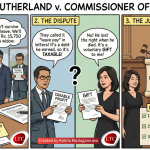
- Case Name: Sutherland v. Commissioner of Income Tax (1951)
- Parties Involved: Mrs. A.J. Sutherland (the Appellant, widow, and Executrix of the estate) vs. The Commissioner of Income Tax (Respondent)
- Subject: Whether a payment made to a widow by her husband’s employer after his death constitutes taxable “profits from employment” or a non-taxable gift.
1. The Facts (The Story)
Mr. R.W. Sutherland was the Managing Director of the Colombo Apothecaries Company Limited.
- The Contract: He had a four-year contract that included six months of full-pay leave.
- The Situation: Mr. Sutherland worked from November 1939 until his death on June 12, 1946, without taking any leave.
- The Payment: After his death, the company’s Board of Directors passed a resolution to pay his widow, Mrs. Sutherland, a sum of Rs. 15,750.
- The Company’s Wording: The Directors’ resolution noted that this money had been reserved to meet a “contingent liability” for leave pay Mr. Sutherland would have been entitled to “if he had survived”. However, company officials casually referred to this money in letters as “overdue leave pay” and “accumulated furlough pay”.
2. The Dispute
The core disagreement was about how to classify this Rs. 15,750.
- The Tax Commissioner’s Argument: The money was taxable “profits from employment” because it represented “leave pay” earned by Mr. Sutherland under his contract. They argued it was a debt owed to him that accrued to his account before he died.
- The Appellant’s (Mrs. Sutherland’s) Argument: The money was an ex gratia payment (a gift) made personally to her. Her husband had lost his right to the leave pay because he died before taking it, so the company was not legally obligated to pay it to his estate.
3. The Judgment (Held)
The Court ruled in favor of Mrs. Sutherland. The payment was NOT taxable.
Reasons for the Decision:
- No Legal Entitlement: The Court found no evidence that the deceased had a vested right to demand money in lieu of leave while he was alive. The Directors’ resolution specifically stated the money was for a liability he would have been entitled to only if he had survived. Since he died, the entitlement died with him.
- Nature of a Gift: The payment was a personal gift to the widow from her husband’s former employer. It was not a payment to the deceased’s estate for a debt due to him.
- Irrelevance of Labels: The Court ruled that it did not matter that company officials used terms like “overdue leave pay” in their letters. A taxpayer should not be penalized for the specific words or labels chosen by the payer if the actual nature of the transaction proves otherwise.
4. Key Takeaways
- Motive vs. Legal Obligation: Even if the motive for a payment is to compensate for work (like untaken leave), if the employee had no legal right to demand that money at the time of death, a voluntary payment to the widow is treated as a gift, not salary.
- Substance Over Form: The labels used by a company (e.g., calling a payment “accrued pay”) do not determine tax liability. The court looks at the true legal nature of the payment.
- Contingent vs. Vested: Distinguishing between a “contingent liability” (something that might be owed if certain conditions are met) and a “vested right” (something definitely owed) is crucial in tax law.